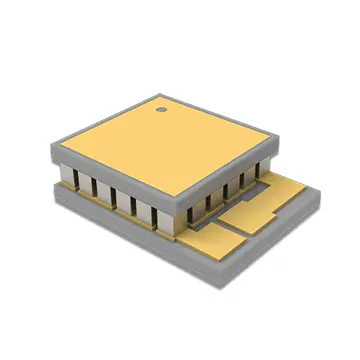
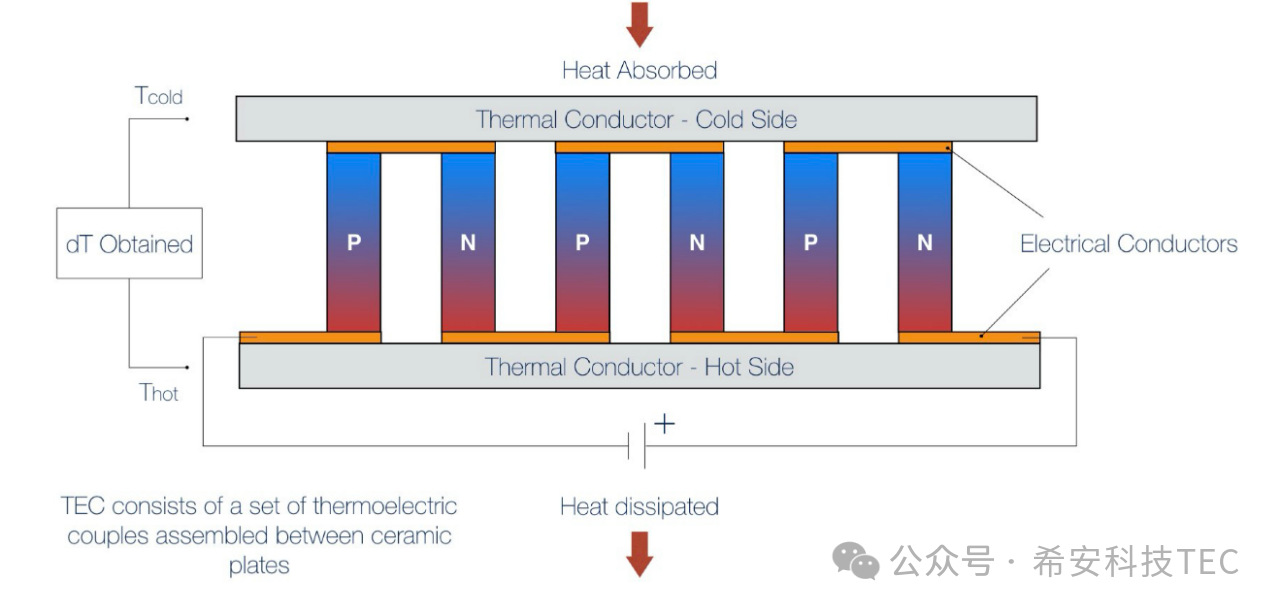
To better understand how TEC works, let's first take a look at its internal structure. The core of TEC is the semiconductor thermocouple (grain), which is generally divided into P-type and N-type.
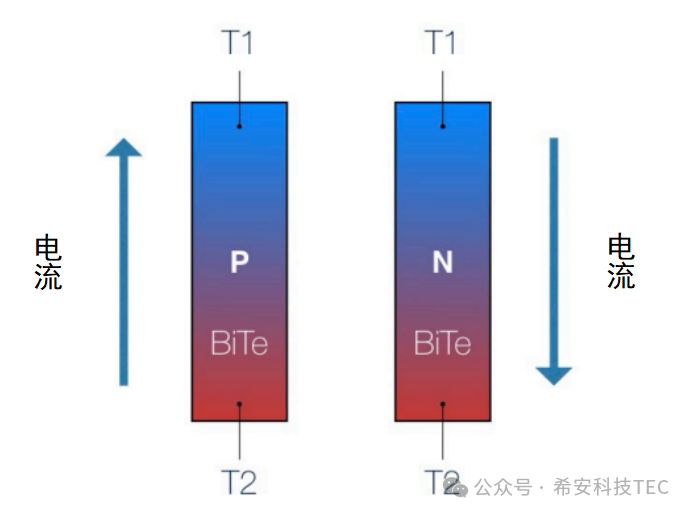
When direct current passes through a thermocouple, the P-type and N-type semiconductor grains (P-type (doped with trivalent elements such as boron, which have holes) conduct electricity through holes and become positively charged; A pair of N-type (doped with pentavalent elements such as phosphorus) that conducts electricity by electrons and is negatively charged.
At the cold end, the carriers will jump from a lower energy level to a higher one. During the energy level transition process, heat is absorbed, thus achieving a cooling effect. Meanwhile, when the carriers at the hot end recombine, energy is released, resulting in an exothermic phenomenon. If direct current is passed in the opposite direction, the cooling effect will be transformed into heating.

The PN junction, through the conductive layer, forms a thermocouple and is the core structural component of TEC. A single pair of thermocouples can also achieve the functions of cooling or heating after being powered on.
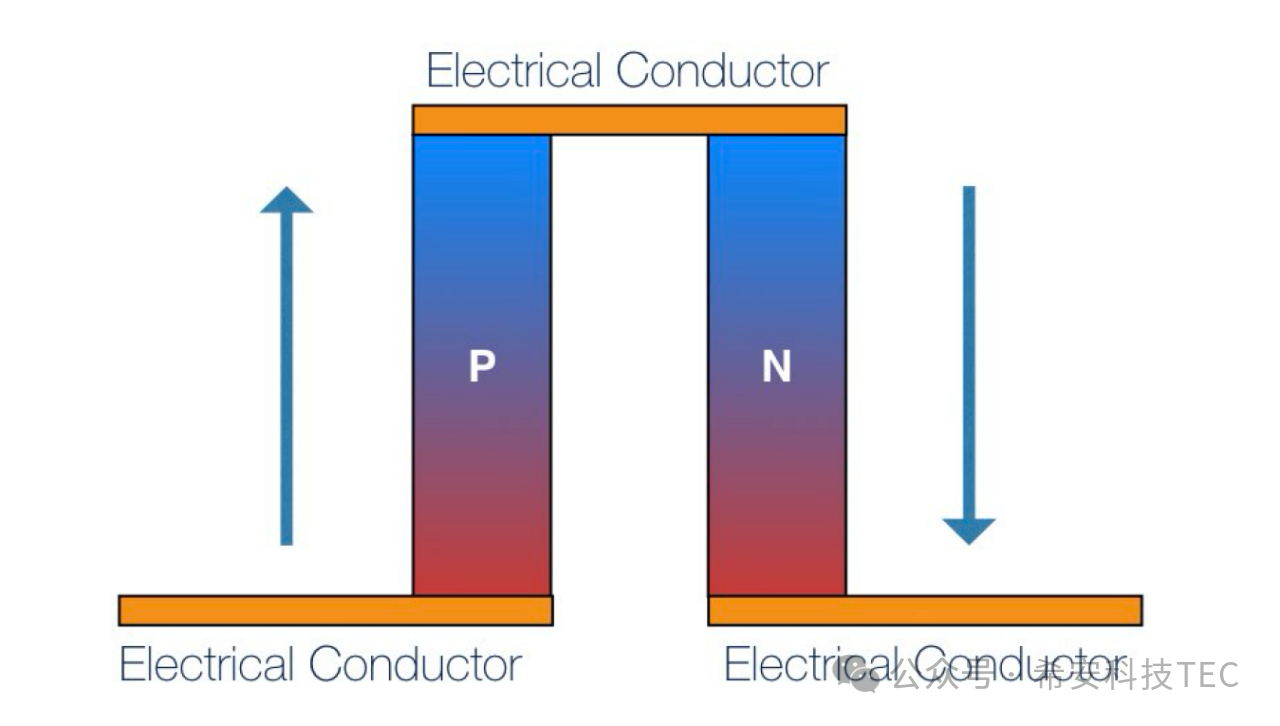
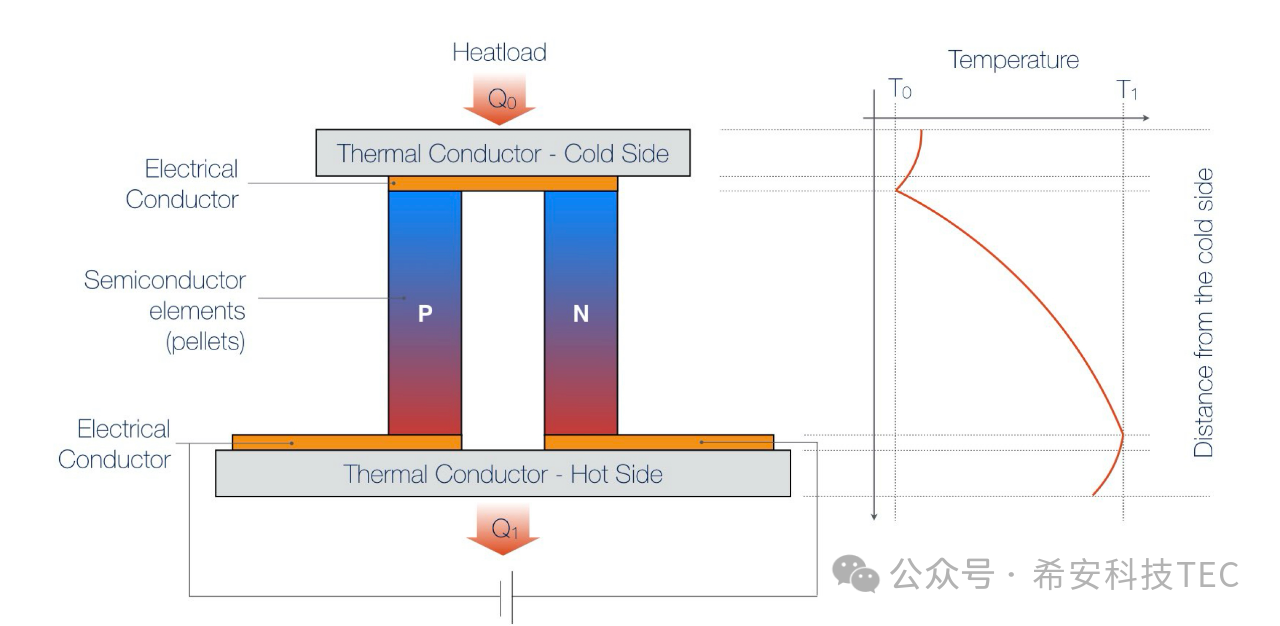
Thermal conductors are added to both ends of the thermocouple as shown in the following figure: a complete TEC is formed. When the TEC is powered, the upper surface will absorb heat, which is called the cold end, and the absorbed heat is Q0. The lower surface releases heat and is called the hot surface, with the heat released being Q1 ; Q1= Q0+Qtec
The temperature difference between the upper and lower surfaces due to heat absorption and heat release is ΔT,ΔT=T1-T0
In daily use, TEC is usually composed of multiple pairs of PN junctions. To achieve a greater cooling capacity or temperature difference.
After reading the article, it's time to pay attention to the blackboard again:
Q: What is the relationship between the heat Qc absorbed at the cold end and the heat Qt released at the hot end?
A: Qc=Qt-Qtec.
Q: Why do the cold and hot ends absorb and release heat respectively?
A: At the cold end, the carriers will jump from a lower energy level to a higher one. The process of energy level transition absorbs heat, thus achieving a cooling effect. Meanwhile, when the carriers at the hot end recombine, they release energy, resulting in an exothermic phenomenon.
X-Meritan is a professional manufacturer and supplier of Thermoelectric Materials, Thermoelectric Coolers and Thermoelectric Coolers Assemblies in China. Welcome to consult and purchase.