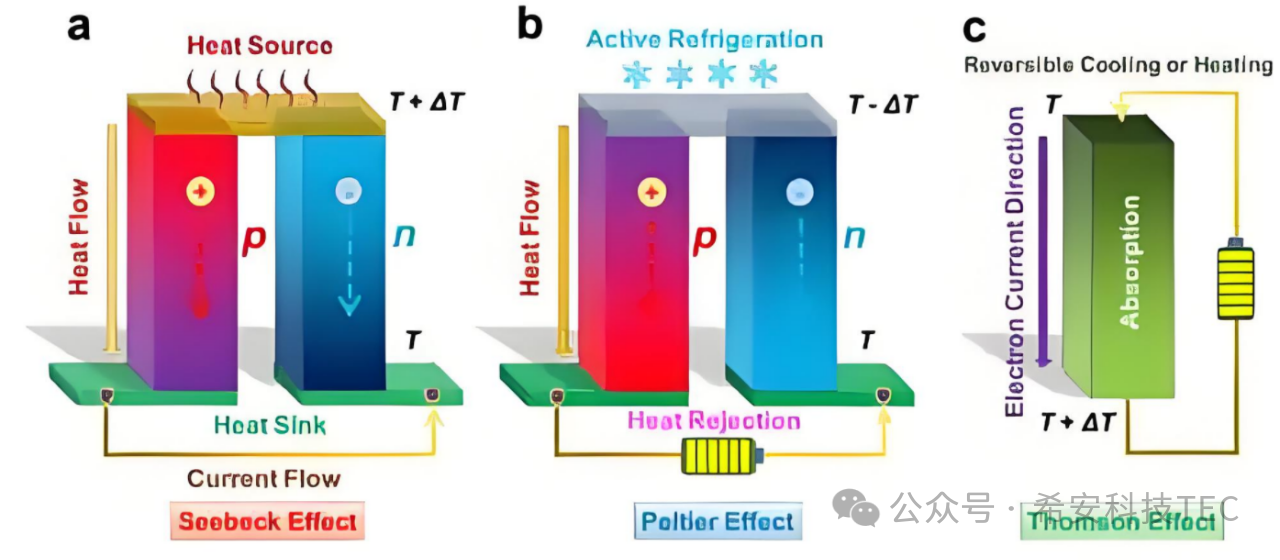
The illustration shows the schematic diagrams of the three major effects in our thermoelectric field: they are the Seebeck effect, the Peltier effect and the Thomson effect. This time, we are going to explore William Thomson and his great discovery - the Thomson effect.
William Thomson was born in Ireland in 1824. His father, James, was a mathematics professor at the Royal College Belfast. Later, as he was teaching at the University of Glasgow, his family moved to Glasgow, Scotland when William was eight years old. Thomson entered the University of Glasgow at the age of ten (you needn't be surprised that in that era, Irish universities would admit the most talented primary school students), and began to study university-level courses around the age of 14. At the age of 15, he won a university gold medal for an article titled "The Shape of the Earth". Thomson later went to study at Cambridge University and graduated as the second top student in his grade. After graduation, he went to Paris and conducted a year of experimental research under the guidance of Rene. In 1846, Thomson returned to the University of Glasgow to serve as a professor of natural philosophy (i.e., physics) until his retirement in 1899.

Thomson established the first modern physics laboratory at the University of Glasgow. At the age of 24, he published a monograph on thermodynamics and established the "absolute thermodynamic temperature scale" for temperature. At the age of 27, he published the book "Theory of Thermodynamics", establishing the second law of thermodynamics and making it a fundamental law of physics. Jointly discovered the Joule-Thomson effect during gas diffusion with Joule; After nine years of building a permanent Atlantic submarine cable between Europe and America, he was awarded the noble title of "Lord Kelvin".
Thomson's research scope was quite extensive throughout his life. He made significant contributions in mathematical physics, thermodynamics, electromagnetism, elasticity mechanics, ether theory and earth science.
In 1856, Thomson conducted a comprehensive analysis of the Seebeck effect and the Peltier effect by applying the thermodynamic principles he had established, and established a connection between the originally unrelated Seebeck coefficient and the Peltier coefficient. Thomson believed that at absolute zero, there is a simple multiple relationship between the Peltier coefficient and the Seebeck coefficient. On this basis, he theoretically predicted a new thermoelectric effect, that is, when current flows through a conductor with uneven temperature, in addition to generating irreversible Joule heat, the conductor also absorbs or releases a certain amount of heat (known as Thomson heat). Or conversely, when the temperatures at both ends of a metal rod are different, an electric potential difference will be formed at both ends of the metal rod. This phenomenon was later called the Thomson effect and became the third thermoelectric effect after the Seebeck effect and the Peltier effect.
The story is over. Here's the key point!
Q: What are the three major thermoelectric effects respectively?
A: The Seebeck effect, also known as the first thermoelectric effect, refers to the thermoelectric phenomenon caused by the temperature difference between two different conductors or semiconductors, resulting in A voltage difference between two substances.
The Peltier effect, also known as the second thermoelectric effect, refers to the phenomenon where, when current passes through the contact point formed by conductors A and B, in addition to the Joule heat generated due to the current flowing through the circuit, there is also an endothermic or exothermic effect at the contact point. It is the reverse reaction of the Seebeck effect. Since Joule heat is independent of the direction of the current, Peltier heat can be measured by applying electricity twice in the opposite direction.
The Thomson effect, also known as the third thermoelectric effect, was proposed by Thomson to have a simple multiple relationship between the Peltier coefficient and the Seebeck coefficient at absolute zero. On this basis, he theoretically predicted a new thermoelectric effect, that is, when current flows through a conductor with uneven temperature, in addition to generating irreversible Joule heat, the conductor also absorbs or releases a certain amount of heat (known as Thomson heat). Or conversely, when the temperatures at both ends of a metal rod are different, an electric potential difference will be formed at both ends of the metal rod.
Q: What is the relationship among these three thermoelectric effects?
A: The three thermoelectric effects have certain connections: The Thomson effect is the phenomenon where an electric potential is generated when there is a temperature difference between the two ends of a conductor; the Pellier effect is the phenomenon where a temperature difference is produced between the two ends of a charged conductor (one end generates heat and the other end absorbs heat). The combination of the two constitutes the Seebeck effect.
In summary, the thermoelectric effect refers to the phenomenon that when there is a temperature difference at the contact point of two materials, an electric potential difference and current will occur. The Seebeck effect converts thermal energy into electrical energy, the Peltier effect realizes the mutual conversion between electrical and thermal energy, and the Thomson effect describes the thermal effect when current passes through a material.
X-Meritan is a professional manufacturer and supplier of Thermoelectric Materials, Thermoelectric Coolers and Thermoelectric Coolers Assemblies in China. Welcome to consult and purchase.