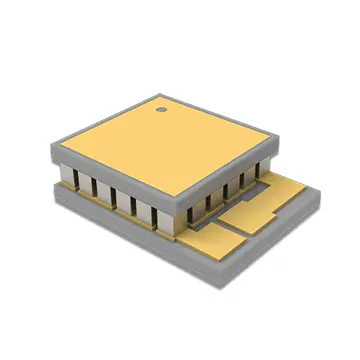
How to choose the best TEC? Let's first take a look at a model and calculation formula of TEC with X-meritan.
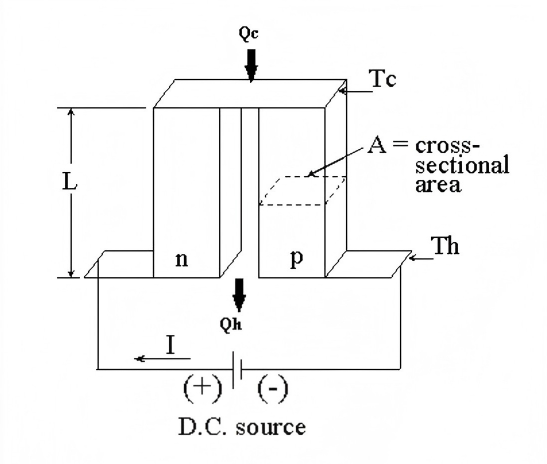
The above picture shows a thermocouple pair. First, let's introduce the concepts of each parameter in the following picture, which will be used in mathematical equations later.
The following are two of the most fundamental equations: load Qc and voltage calculation
1, Qc = 2 * N * [S * I * * * * - 1/2 the I ^ 2 * R * A/L L/A - K * * (Th - Tc)]
2. V = 2 * N * [S * (Th -Tc) + I * R * L/A]
In the first Qc calculation formula, the first term: S *I * Tc represents the Peltier cooling effect, and the second term, 1/2*I^2*R*L/A, indicates the Joule heat effect generated when current passes through a resistor. Joule heat is distributed throughout the component, so half of the heat flows to the cold side and the other half to the hot side. The last term, K*A/L*(Th-Tc), represents the Fourier effect, that is, heat is conducted from high temperature to low temperature. Therefore, the cooling effect of Peltier will be weakened due to the losses caused by resistance and thermal conductivity.
For voltage, the first term S*(Th-Tc) represents the Seebeck voltage. The second term, I*R*L/A, represents the voltage related to Ohm's Law.
After an extremely complex derivation, the advanced mathematics has almost been forgotten, so the derivation process is omitted here. The result is the most important. Then, two formulas that are extremely important in TEC selection are obtained:
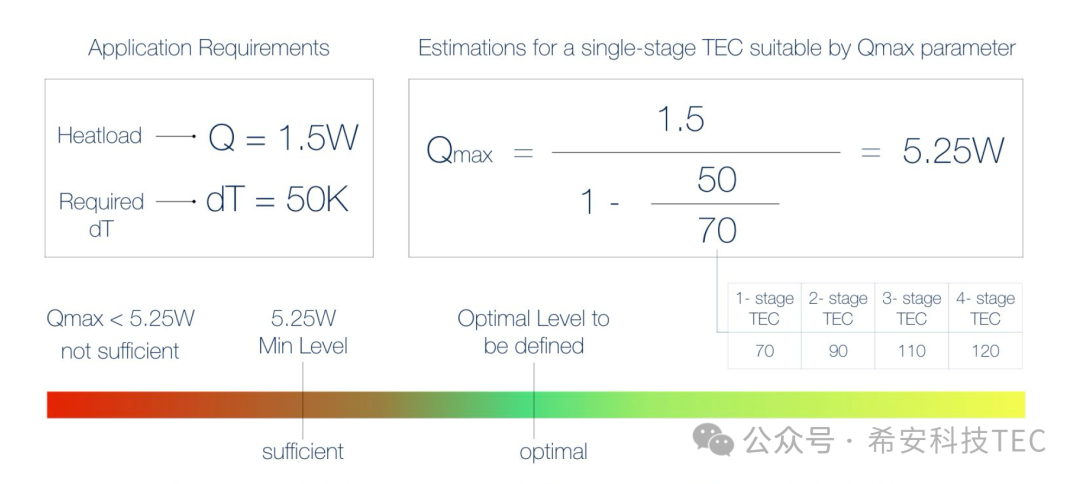
3. Qmax=Qc/(1-Dt/Dtmax
4. COP(Coefficient of Performance)=Qc/Qtec
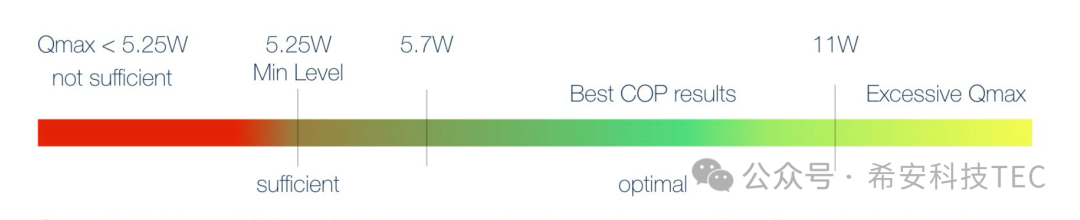
The core requirements for TEC selection: load Qc, operating temperature Tc, hot end temperature Th, Dt=Th-Tc. For instance: Qc=1.5W, Dt=50K, Qmax=1.5(1-50/70)=5.25W. Is this Qmax 5.25W the optimal solution? No, 5.25 is the smallest Qmax in this application. Qmax is not necessarily the larger the better. If it is larger, the number of PN pairs will be greater, and the energy consumed itself will be more. How to calculate this optimal Qmax is rather complicated and requires very professional thermal design engineers.
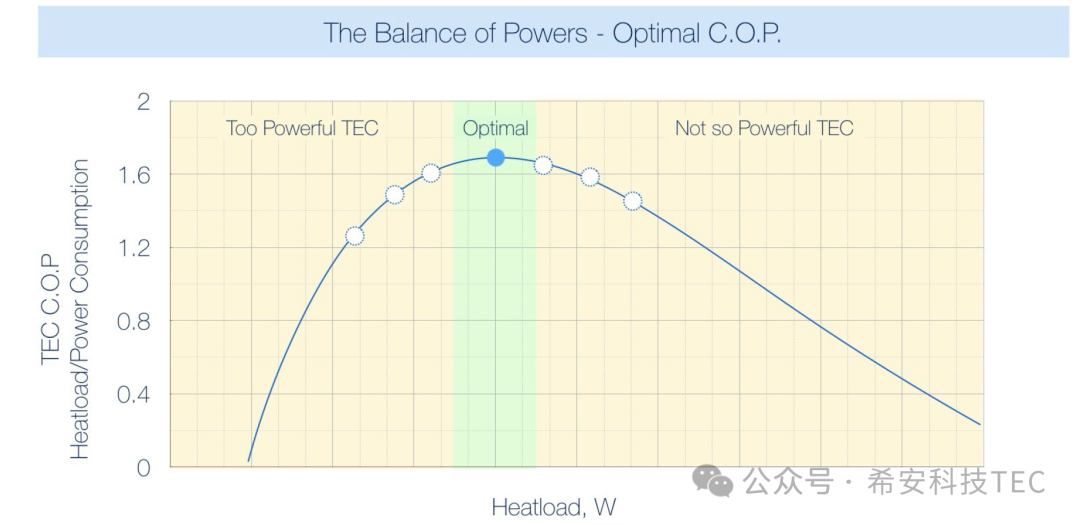
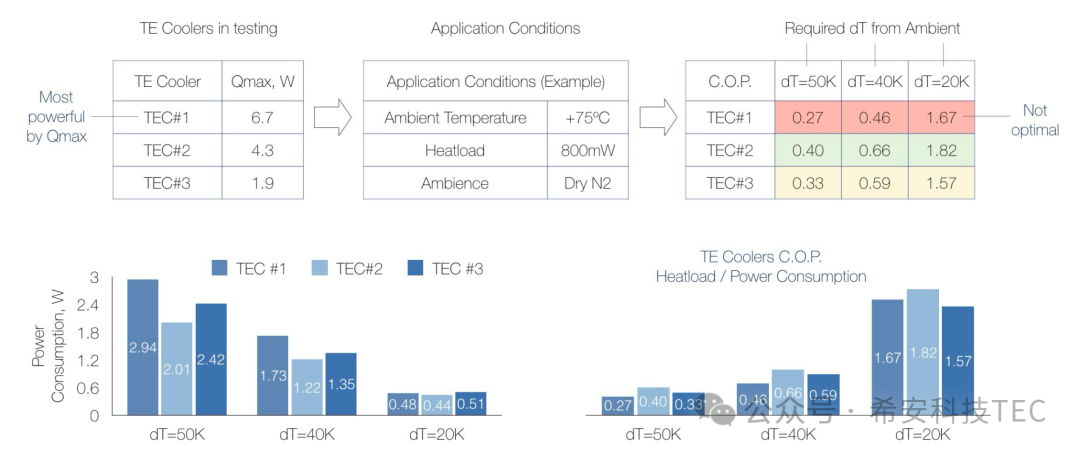
As shown in the following figure, we have selected three groups of TEC, different Qmax, but the same application environment. The COP of TEC# 1 is the lowest, while its Qmax is the largest.
To sum up:
1. The TEC with the highest power is not necessarily the most suitable one; it depends on the specific application.
2. For an application with specific load and temperature difference requirements, it is definitely possible to obtain an optimal solution by calculating the COP.
3. As shown in the following figure, each TEC has an optimal load range (the highest COP value) when Dt is determined.